Showing posts with label historic date. Show all posts

Sunday, June 19, 2011

Juneteenth  G. Rose

Freedoms Plow 
by Langston Hughes
When a man starts out with nothing,
When a man starts out with his hands
Empty, but clean,
When a man starts to build a world,
He starts first with himself
And the faith that is in his heart-
The strength there,
The will there to build.

First in the heart is the dream-
Then the mind starts seeking a way.
His eyes look out on the world,
On the great wooded world,
On the rich soil of the world,
On the rivers of the world.

The eyes see there materials for building,
See the difficulties, too, and the obstacles.
The mind seeks a way to overcome these obstacles.
The hand seeks tools to cut the wood,
To till the soil, and harness the power of the waters.
Then the hand seeks other hands to help,
A community of hands to help-
Thus the dream becomes not one man's dream alone,
But a community dream.
Not my dream alone, but our dream.
Not my world alone,
But your world and my world,
Belonging to all the hands who build.

A long time ago, but not too long ago,
Ships came from across the sea
Bringing the Pilgrims and prayer-makers,
Adventurers and booty seekers,
Free men and indentured servants,
Slave men and slave masters, all new-
To a new world, America!

With billowing sails the galleons came
Bringing men and dreams, women and dreams.
In little bands together,
Heart reaching out to heart,
Hand reaching out to hand,
They began to build our land.
Some were free hands
Seeking a greater freedom,
Some were indentured hands
Hoping to find their freedom,
Some were slave hands
Guarding in their hearts the seed of freedom,
But the word was there always:
Freedom.

Down into the earth went the plow
In the free hands and the slave hands,
In indentured hands and adventurous hands,
Turning the rich soil went the plow in many hands
That planted and harvested the food that fed
And the cotton that clothed America.
Clang against the trees went the ax into many hands
That hewed and shaped the rooftops of America.
Splash into the rivers and the seas went the boat-hulls
That moved and transported America.
Crack went the whips that drove the horses
Across the plains of America.
Free hands and slave hands,
Indentured hands, adventurous hands,
White hands and black hands
Held the plow handles,
Ax handles, hammer handles,
Launched the boats and whipped the horses
That fed and housed and moved America.
Thus together through labor,
All these hands made America.

Labor! Out of labor came villages
And the towns that grew cities.
Labor! Out of labor came the rowboats
And the sailboats and the steamboats,
Came the wagons, and the coaches,
Covered wagons, stage coaches,
Out of labor came the factories,
Came the foundries, came the railroads.
Came the marts and markets, shops and stores,
Came the mighty products moulded, manufactured,
Sold in shops, piled in warehouses,
Shipped the wide world over:
Out of labor-white hands and black hands-
Came the dream, the strength, the will,
And the way to build America.
Now it is Me here, and You there.
Now it's Manhattan, Chicago,
Seattle, New Orleans,
Boston and El Paso-
Now it's the U.S.A.

A long time ago, but not too long ago, a man said:
ALL MEN ARE CREATED EQUAL--
ENDOWED BY THEIR CREATOR
WITH CERTAIN UNALIENABLE RIGHTS--
AMONG THESE LIFE, LIBERTY
AND THE PURSUIT OF HAPPINESS.
His name was Jefferson. There were slaves then,
But in their hearts the slaves believed him, too,
And silently too for granted
That what he said was also meant for them.
It was a long time ago,
But not so long ago at that, Lincoln said:
NO MAN IS GOOD ENOUGH
TO GOVERN ANOTHER MAN
WITHOUT THAT OTHER'S CONSENT.
There were slaves then, too,
But in their hearts the slaves knew
What he said must be meant for every human being-
Else it had no meaning for anyone.
Then a man said:
BETTER TO DIE FREE
THAN TO LIVE SLAVES
He was a colored man who had been a slave
But had run away to freedom.
And the slaves knew
What Frederick Douglass said was true.

With John Brown at Harper's Ferry, Negroes died.
John Brown was hung.
Before the Civil War, days were dark,
And nobody knew for sure
When freedom would triumph
"Or if it would," thought some.
But others new it had to triumph.
In those dark days of slavery,
Guarding in their hearts the seed of freedom,
The slaves made up a song:
Keep Your Hand On The Plow! Hold On!
That song meant just what it said: Hold On!
Freedom will come!
Keep Your Hand On The Plow! Hold On!
Out of war it came, bloody and terrible!
But it came!
Some there were, as always,
Who doubted that the war would end right,
That the slaves would be free,
Or that the union would stand,
But now we know how it all came out.
Out of the darkest days for people and a nation,
We know now how it came out.
There was light when the battle clouds rolled away.
There was a great wooded land,
And men united as a nation.

America is a dream.
The poet says it was promises.
The people say it is promises-that will come true.
The people do not always say things out loud,
Nor write them down on paper.
The people often hold
Great thoughts in their deepest hearts
And sometimes only blunderingly express them,
Haltingly and stumblingly say them,
And faultily put them into practice.
The people do not always understand each other.
But there is, somewhere there,
Always the trying to understand,
And the trying to say,
"You are a man. Together we are building our land."

America!
Land created in common,
Dream nourished in common,
Keep your hand on the plow! Hold on!
If the house is not yet finished,
Don't be discouraged, builder!
If the fight is not yet won,
Don't be weary, soldier!
The plan and the pattern is here,
Woven from the beginning
Into the warp and woof of America:
ALL MEN ARE CREATED EQUAL.
NO MAN IS GOOD ENOUGH
TO GOVERN ANOTHER MAN
WITHOUT HIS CONSENT.
BETTER DIE FREE,
THAN TO LIVE SLAVES.
Who said those things? Americans!
Who owns those words? America!
Who is America? You, me!
We are America!
To the enemy who would conquer us from without,
We say, NO!
To the enemy who would divide
And conquer us from within,
We say, NO!
FREEDOM!
BROTHERHOOD!
DEMOCRACY!
To all the enemies of these great words:
We say, NO!

A long time ago,
An enslaved people heading toward freedom
Made up a song:
Keep Your Hand On The Plow! Hold On!
The plow plowed a new furrow
Across the field of history.
Into that furrow the freedom seed was dropped.
From that seed a tree grew, is growing, will ever grow.
That tree is for everybody,
For all America, for all the world.
May its branches spread and shelter grow
Until all races and all peoples know its shade.
KEEP YOUR HAND ON THE PLOW! HOLD ON!

Monday, April 18, 2011

The Eighteenth of April

Paul Revere's Ride  N. C. Wyeth
Paul Revere's Ride
by Henry Wadsworth Longfellow
Listen my children and you shall hear
Of the midnight ride of Paul Revere,
On the eighteenth of April, in Seventy-five;
Hardly a man is now alive
Who remembers that famous day and year.

He said to his friend, "If the British march
By land or sea from the town to-night,
Hang a lantern aloft in the belfry arch
Of the North Church tower as a signal light,--
One if by land, and two if by sea;
And I on the opposite shore will be,
Ready to ride and spread the alarm
Through every Middlesex village and farm,
For the country folk to be up and to arm."

Then he said "Good-night!" and with muffled oar
Silently rowed to the Charlestown shore,
Just as the moon rose over the bay,
Where swinging wide at her moorings lay
The Somerset, British man-of-war;
A phantom ship, with each mast and spar
Across the moon like a prison bar,
And a huge black hulk, that was magnified
By its own reflection in the tide.

Meanwhile, his friend through alley and street
Wanders and watches, with eager ears,
Till in the silence around him he hears
The muster of men at the barrack door,
The sound of arms, and the tramp of feet,
And the measured tread of the grenadiers,
Marching down to their boats on the shore.

Then he climbed the tower of the Old North Church,
By the wooden stairs, with stealthy tread,
To the belfry chamber overhead,
And startled the pigeons from their perch
On the sombre rafters, that round him made
Masses and moving shapes of shade,--
By the trembling ladder, steep and tall,
To the highest window in the wall,
Where he paused to listen and look down
A moment on the roofs of the town
And the moonlight flowing over all.

Beneath, in the churchyard, lay the dead,
In their night encampment on the hill,
Wrapped in silence so deep and still
That he could hear, like a sentinel's tread,
The watchful night-wind, as it went
Creeping along from tent to tent,
And seeming to whisper, "All is well!"
A moment only he feels the spell
Of the place and the hour, and the secret dread
Of the lonely belfry and the dead;
For suddenly all his thoughts are bent
On a shadowy something far away,
Where the river widens to meet the bay,--
A line of black that bends and floats
On the rising tide like a bridge of boats.

Meanwhile, impatient to mount and ride,
Booted and spurred, with a heavy stride
On the opposite shore walked Paul Revere.
Now he patted his horse's side,
Now he gazed at the landscape far and near,
Then, impetuous, stamped the earth,
And turned and tightened his saddle girth;
But mostly he watched with eager search
The belfry tower of the Old North Church,
As it rose above the graves on the hill,
Lonely and spectral and sombre and still.
And lo! as he looks, on the belfry's height
A glimmer, and then a gleam of light!
He springs to the saddle, the bridle he turns,
But lingers and gazes, till full on his sight
A second lamp in the belfry burns.

A hurry of hoofs in a village street,
A shape in the moonlight, a bulk in the dark,
And beneath, from the pebbles, in passing, a spark
Struck out by a steed flying fearless and fleet;
That was all! And yet, through the gloom and the light,
The fate of a nation was riding that night;
And the spark struck out by that steed, in his flight,
Kindled the land into flame with its heat.
He has left the village and mounted the steep,
And beneath him, tranquil and broad and deep,
Is the Mystic, meeting the ocean tides;
And under the alders that skirt its edge,
Now soft on the sand, now loud on the ledge,
Is heard the tramp of his steed as he rides.

It was twelve by the village clock
When he crossed the bridge into Medford town.
He heard the crowing of the cock,
And the barking of the farmer's dog,
And felt the damp of the river fog,
That rises after the sun goes down.

It was one by the village clock,
When he galloped into Lexington.
He saw the gilded weathercock
Swim in the moonlight as he passed,
And the meeting-house windows, black and bare,
Gaze at him with a spectral glare,
As if they already stood aghast
At the bloody work they would look upon.

It was two by the village clock,
When he came to the bridge in Concord town.
He heard the bleating of the flock,
And the twitter of birds among the trees,
And felt the breath of the morning breeze
Blowing over the meadow brown.
And one was safe and asleep in his bed
Who at the bridge would be first to fall,
Who that day would be lying dead,
Pierced by a British musket ball.

You know the rest. In the books you have read
How the British Regulars fired and fled,---
How the farmers gave them ball for ball,
>From behind each fence and farmyard wall,
Chasing the redcoats down the lane,
Then crossing the fields to emerge again
Under the trees at the turn of the road,
And only pausing to fire and load.

So through the night rode Paul Revere;
And so through the night went his cry of alarm
To every Middlesex village and farm,---
A cry of defiance, and not of fear,
A voice in the darkness, a knock at the door,
And a word that shall echo for evermore!
For, borne on the night-wind of the Past,
Through all our history, to the last,
In the hour of darkness and peril and need,
The people will waken and listen to hear
The hurrying hoof-beats of that steed,
And the midnight message of Paul Revere.

Thursday, April 14, 2011

April 15, 1865: President Lincoln's Assassination

The Death of Lincoln  Alonzo Chappel
O Captain my Captain!
by  Walt Whitman
O Captain my Captain! our fearful trip is done,
The ship has weathered every rack, the prize we sought is won,
The port is near, the bells I hear, the people all exulting,
While follow eyes the steady keel, the vessel grim and daring;
But O heart! heart! heart!
O the bleeding drops of red,
Where on the deck my Captain lies,
Fallen cold and dead.

O Captain! my Captain! rise up and hear the bells;
Rise up--for you the flag is flung for you the bugle trills,
For you bouquets and ribboned wreaths for you the shores a-crowding,
For you they call, the swaying mass, their eager faces turning;
Here Captain! dear father!
This arm beneath your head!
It is some dream that on the deck,
You've fallen cold and dead.

My Captain does not answer, his lips are pale and still;
My father does not feel my arm, he has no pulse nor will;
The ship is anchored safe and sound, its voyage closed and done;
From fearful trip the victor ship comes in with object won;
Exult O shores, and ring O bells!
But I, with mournful tread,
Walk the deck my Captain lies,
Fallen cold and dead.

Monday, March 7, 2011

Selma, Alabama, 1965

Confrontation at the Bridge  Jacob Lawrence
Democracy 
by Langston Hughes
Democracy will not come
Today, this year
Nor ever
Through compromise and fear.

I have as much right 
As the other fellow has
To stand
On my two feet 
And own the land.

I tire so of hearing people say, 
Let things take their course.
Tomorrow is another day.
I do not need my freedom when I'm dead.
I cannot live on tomorrow's bread.

Freedom
Is a strong seed
Planted
In a great need.

I live here, too.
I want freedom
Just as you.

Tuesday, February 22, 2011

February 22, 1732

Washington Crossing the Delaware  Emanuel Gottlieb Leutze
George Washington Poem 
by the Boston Gazette
Great hero! whose illustrious actions claim
Eternal blessings and an endless fame--
Of every virtue and each gift possess
Religion reigns triumphant in his breast.
Grant him, almighty God! thy aid and health
Ever to rule these states and guard their wealth.

What power of Language can enough extoll
A Son of Liberty and friend to all--
Saviour and patron of Columbia!
Her sons revere thee and exult this day--
In thee, their Favourite and firm support--
Nations applaud thee and thy friendship court.
Generous deliverer of thy Country's right!
Thou hast prov'd victor over lawless might.
Of all the Conquerors in the historic page,
None have surpass'd this Phonix of the age.

Saturday, February 12, 2011

February 12, 1809

Abraham Lincoln  George P. A. Healy
From his Second Inaugural Address
by President Abraham Lincoln
With malice toward none, 
with charity for all, 
with firmness in the right 
as God gives us to see the right, 
let us strive on to finish the work we are in, 
to bind up the nation's wounds, 
to care for him who shall have borne the battle 
and for his widow and his orphan, 
to do all which may achieve and cherish a just and lasting peace 
among ourselves and with all nations

Sunday, February 6, 2011

February 6, 1911

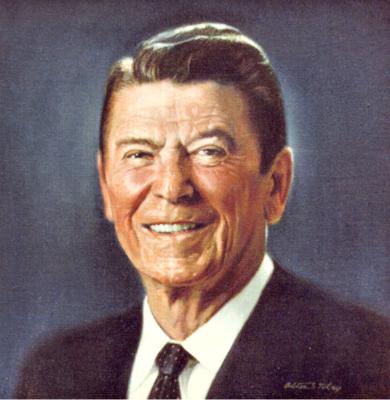
Ronald Reagan  Alton Tobey

Above all, we must realize 
that no arsenal, 
or no weapon in the arsenals of the world, 
is so formidable 
as the will and moral courage 
of free men and women. 
It is a weapon our adversaries in today's world do not have. 

Freedom is never more than one generation away from extinction. 
We didn't pass it to our children in the bloodstream. 
It must be fought for, 
protected, 
and handed on for them to do the same, 
or one day we will spend our sunset years 
telling our children and our children's children
what it was once like in the United States where men were free.

The government's view of the economy 
could be summed up in a few short phrases: 
If it moves, tax it. 
If it keeps moving, regulate it. 
And if it stops moving, subsidize it. 

The nine most terrifying words in the English language are, 
'I'm from the government and I'm here to help.'

The ultimate determinant
in the struggle now going on for the world 
will not be bombs and rockets 
but a test of wills and ideas-
a trial of spiritual resolve: 
the values we hold, 
the beliefs we cherish 
and the ideals to which we are dedicated.

A people free to choose will always choose peace.

You and I have a rendezvous with destiny.
We will preserve for our children this,
the last best hope of man on earth, 
or we will sentence them to take the first step 
into a thousand years of darkness. 
If we fail, 
at least let our children and 
our children's children 
say of us 
we justified our brief moment here. 
We did all that could be done.

Inflation is as violent as a mugger,
 as frightening as an armed robber
 and as deadly as a hit man.

Mr Gorbachev, tear down this wall! 

Man is not free unless government is limited.

Protecting the rights 
of even the least individual among us 
is basically the only excuse the government has 
for even existing.

We can't help everyone, but everyone can help someone. 

We have the duty to protect the life of an unborn child.

 We must reject the idea that every time a law's broken, 
society is guilty rather than the lawbreaker. 
It is time to restore the American precept 
that each individual is accountable for his actions.
Welfare's purpose should be to eliminate, as far as possible, 
the need for its own existence.

We should measure welfare's success 
by how many people leave welfare, 
not by how many are added.

Freedom prospers 
when religion is vibrant 
and the rule of law under God is acknowledged.

Monday, November 22, 2010

Novemeber 22, 1963

President John F. Kennedy  Cecil Calvert Beall
From Inaugural Address
by John F. Kennedy, January 20th 1961
And so, my fellow Americans: 
ask not what your country can do for you - 
ask what you can do for your country.

My fellow citizens of the world: 
ask not what America will do for you, 
but what together we can do for the freedom of man.

Finally, whether you are citizens of America or citizens of the world, 
ask of us the same high standards of strength and sacrifice which we ask of you. 
With a good conscience our only sure reward, 
with history the final judge of our deeds, 
let us go forth to lead the land we love, 
asking His blessing and His help, 
but knowing that here on earth 
God's work must truly be our own.

Friday, November 19, 2010

November 19, 1863

The Gettysburg Address  Mort Kunstler
The Gettysburg Address
by Abraham Lincoln
Four score and seven years ago 
our fathers brought forth, upon this continent, 
a new nation, conceived in Liberty, 
and dedicated to the proposition that all men are created equal.

Now we are engaged in a great civil war, 
testing whether that nation, 
or any nation so conceived, and so dedicated, 
can long endure. 
We are met here on a great battlefield of that war. 
We have come to dedicate a portion of it as a final resting place 
for those who here gave their lives that that nation might live. 
It is altogether fitting and proper that we should do this.

But in a larger sense we can not dedicate - 
we can not consecrate - 
we can not hallow this ground. 
The brave men, 
living and dead, 
who struggled, here, 
have consecrated it far above our poor power to add or detract. 
The world will little note, 
nor long remember, 
what we say here, 
but can never forget what they did here.

It is for us, the living, 
rather to be dedicated here 
to the unfinished work which they have, 
thus far, so nobly carried on. 
It is rather for us to be here dedicated 
to the great task remaining before us - 
that from these honored dead 
we take increased devotion to that cause 
for which they here gave the last full measure of devotion - 
that we here highly resolve 
that these dead shall not have died in vain; 
that this nation shall have a new birth of freedom; 
and that this government of the people, 
by the people, 
for the people, 
shall not perish from the earth.